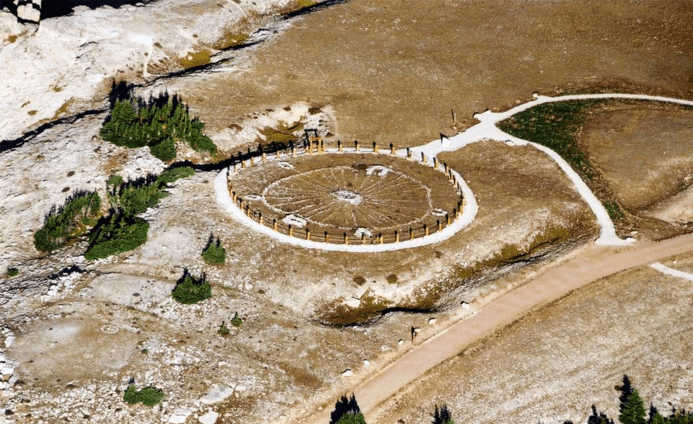
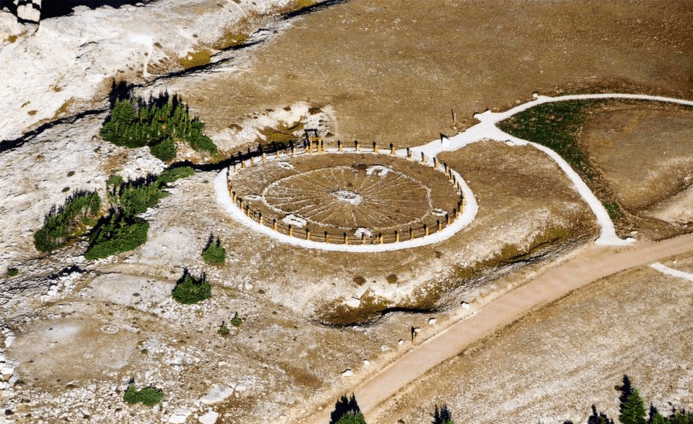
A recurring concept in indigenous culture that emerges is the medicine wheel. Its significance and meaning changes depending on the context and is unique to each indigenous culture however they all share an underlying unifying meaning of the importance of interconnectedness and interrelatedness of all things (Bell, 2014). The meanings can range from representing the stages of life (infant, youth, adult, elder), the seasons (spring, summer, fall, winter), the elements of nature (earth, sun, water, air), time of day (morning, afternoon, evening, night) or the aspects of life (mental, spiritual, physical, emotional) (Bell, 2014). Additionally, they can take on many forms through paintings, artifacts or physical construction such as the Bighorn medicine wheel in Wyoming which is one of the largest and well-known medicine wheels (Chapman, 2019).
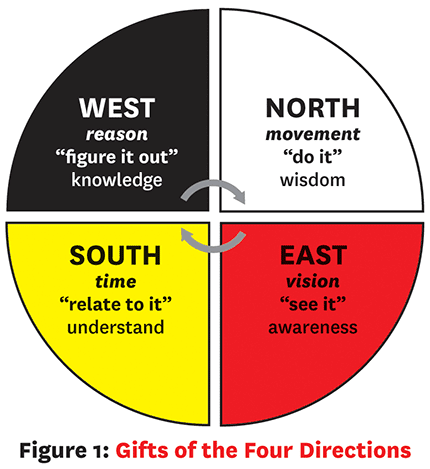
The medicine wheel drawing begins with a circle with four equidistant points representing the four directions of north, south, east and west with four different colours usually in black, white, red and yellow. These four directions have been used as a tool to gain greater understanding of non-physical things in our world. The medicine wheel can be used as a pedagogical tool for understanding, teaching and learning human journey from an individual level to a global or even cosmic scale. The medicine wheel includes the gifts of directions. In the East lies the gift of vision where one can “see”. In the South the gift of time allows one to relate to the vision. In the West one uses the gift of reason to figure out what they have seen. Finally, in the North one uses the gift of movement to actualize their vision. This reflects the learning process provided by the medicine wheel as each gift correspond to a particular process which include awareness, understanding, knowledge and wisdom (Bell, 2014).
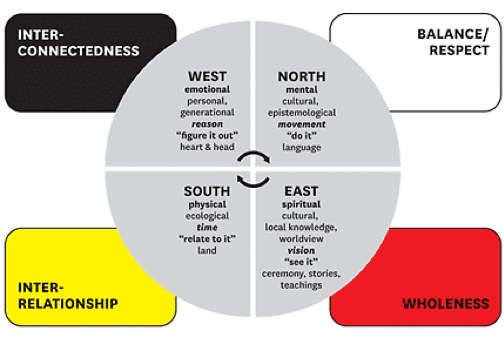
Indigenous knowledge as exemplified by the medicine wheel include aspects of wholeness, interrelationships, interconnections, and balance/respect (Bell, 2014). One is required to look at the whole as greater than the sum of its parts and that the parts can only be recognized when the shape of the whole is seen. As nurses this is a relevant aspect as we should see our patients not by their physical processes that we treat but the patient as a whole. Interrelationships requires one to establish a relationship with all that surrounds us as well as our whole being including our physical, spiritual, mental and emotional aspects. Interconnections require one to recognize their environment and everything in it as something to be respected and revealing the dynamic interdependence of all objects in the universe. Balance provides structure for all the interconnections and interrelationships and the whole and respect is the appreciation of it all. The fundamental concepts of wholeness, interrelationship, interconnectedness and balance/respect are valuable for all including nurses.
The teaching of indigenous ways of thinking such as the medicine wheel in nursing theory courses is absent at York University. Yet we see their value in providing one a holistic mindset in regard to healing as well as expanding one’s cultural competence. The inclusion of indigenous courses into Canadian nursing curriculum should be mandatory because the invisibility of Aboriginal health in nursing discourse may represent a subtle racism to an already marginalized and important cultural group. Additionally, it will further the profession by broadening the nursing body of knowledge, supporting cultural identity and promoting diversity within the nursing profession and better prepare graduates to provide care for all people.
References
Bell, N. (2014). Teaching by the Medicine Wheel. EdCan Network. Retrieved from https://www.edcan.ca/articles/teaching-by-the-medicine-wheel/
Chapman, F. (2019). Medicine Wheel/Medicine Mountain: Celebrated and Controversial Landmark. In WyoHistory.org. Retrieved from https://www.wyohistory.org/encyclopedia/medicine-wheel
Joseph, B. (2013). What is the Aboriginal medicine wheel?. Retrieved from https://www.ictinc.ca/blog/what-is-an-aboriginal-medicine-wheel
The Medicine Wheel and the Four Directions. (n.d). Retrieved from https://www.nlm.nih.gov/nativevoices/exhibition/healing-ways/medicine-ways/medicine-wheel.html
Thurston, J.M., & Mashford-Pringle, A. (2015). Nursing & indigenous education integration. Journal of Nursing Education and Practice, 5(10), 9-15. doi: 10.5430/jnep.v5n10p9


Very thought provoking post. I agree that this should be a mandatory part of ALL health professions – nursing, medicine, and so on.
LikeLike
Thanks for your input!
LikeLike